

Essay
探究エッセイー A Tankyu Essay
サクランボ狩りと牛のフン:情報過多時代の「嘘」と「デタラメ」を見抜く
情報過多の現代社会を生き抜く私たちは、日々「サクランボ狩り(Cherry-picking)」、つまり都合のいい情報だけを選ぶことで自己防衛を図っています。しかし、この行為の積み重ねが、やがて真実を軽視する「牛のフン(Bullshit)」文化を蔓延させ、社会的な分断や搾取を加速させているとしたら?本エッセイは、「いいとこ取り」の処世術が、いかにして現代の政治的・社会的な「デタラメ」に加担しているかを鋭く考察します。哲学者ヴィトゲンシュタインらの概念を用い「嘘」と「ホラ(Bullshit)」の違いを明確にしながら、情報操作のプロとなるか、真実を追求する孤高の存在となるかという二択を超える、第三の道を提案。フンまみれの社会で、私たちが今なすべきことは何か。この問いへの答えを、あなたも見つけませんか?
Cherry-picking and Bullshit: Navigating Truth in the Information Age
In our hyper-connected world, we all engage in “Cherry-picking”—selectively using convenient information for self-preservation. But what if this common survival tactic paves the way for a culture saturated with “Bullshit,” accelerating social division and exploitation?
This compelling essay delves into how our habit of “picking the good parts” contributes to modern political and social deceit. Drawing on concepts from thinkers like Wittgenstein, it clearly distinguishes between a deliberate “lie” and self-serving “bullshit.” The piece challenges the reader: Must we become masters of information manipulation or isolated truth-seekers? It proposes a third way to maintain integrity and effectiveness in a “shit-filled” society. Discover how to navigate this reality and find your role in clearing up the global mess.
ボタンをクリックすると、英語または日本語で全文を読むことができます。
Click the buttons to read in full in English or Japanese.
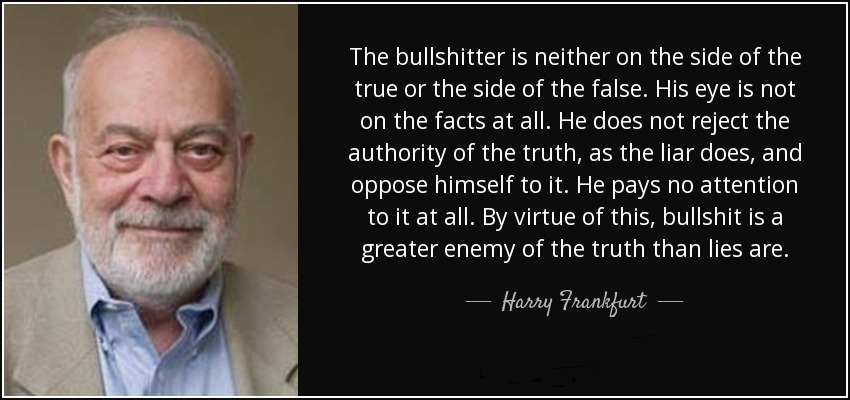
Harry G. Frankfurt
Harry G. Frankfurt was an American philosopher. Frankfurt made significant contributions to such fields as ethics and philosophy of mind. The attitude of caring played a central role in his philosophy. His most popular book is On Bullshit, which discusses the distinction between bullshitting and lying.

Chapter 1
サクランボ狩りの妙
– The Art of Cherry-picking –
There is a term called “cherry-picking.” It means “taking only the good parts” or “selecting only the convenient parts”, and it is largely practiced in the context of information manipulation. Cherry-picking (like picking cherries) is when a person, presented with a body of information, prioritises the persuasion of their own argument or the achievement of their goal over accurately conveying the facts, and selects only the convenient parts, shaping them in a favourable way.
The English term cherry-picking is derived from the literal act of choosing only the ripe, sweet cherries and leaving the unripe, unappetising ones behind. The Japanese equivalent is “sakuranbo gari” (cherry hunting or gathering). The notion of “hunting cherries” might sound funny to English speakers, but this usage stems from a centuries-old tradition. It originates from the 7th century practice where the noble class called the act of walking through the woods to enjoy the autumn red leaves “Momiji-gari” (red leaf hunting), as they would essentially chase the spectacle of the turning leaves across the forest. The English concept of transitioning the verb “picking” to mean “taking only the good parts” is a fresh idea to Japanese sensibilities.
Cherry-picking is widely used by various science denialists. For instance, a person who wants to deny global warming can intentionally show only certain data from a specific time period, omitting all other observation data, to present results suggesting that global warming has paused. High-quality science focuses on all evidence, without selectively choosing, in an attempt to find the inherent patterns and logic. In contrast, low-quality science uses cherry-picking to gather evidence that supports an existing conclusion or assertion, thereby fabricating “facts.”
We all live by cherry-picking. During job interviews, for example, we appeal with our qualifications and awards, or only share stories of failure when we can artfully transform them into a heroic tale. We all commonly engage in this kind of information manipulation as a life skill to get by. Conversely, a failure to do this often results in being marginalised or losing one’s place in society. It’s not hard to imagine a scenario where a bully who participated in volunteer activities passes an interview exam, while a sensitive, excellent person who resists self-promotion is rejected. This clearly shows that university entrance exams are an entry point to society and a competitive arena based on the premise that everyone is cleverly manipulating information to survive. The ability to push one’s claims or achieve one’s objectives is often valued more highly than being a good person or being honest.
1.1
確証バイアスとホラの時代
– Confirmation Bias and the Era of Bullshit –
We all possess a brain tendency known as confirmation bias, which makes us focus only on evidence that supports our existing beliefs. Whether intentional or not, our brains are actively engaged in cherry-picking. This attitude is evident in how we treat politicians or parties we support: only positive information is repeatedly accepted, and when they cause problems, we dismiss the reports claiming that “the evidence is insufficient.”
Looking across the Pacific, on May 30, 2024, U.S. President Donald Trump became the first American president convicted of a crime after a New York State Supreme Court jury found him guilty on 34 felony counts. Why does he still have supporters despite being a convicted felon? His base, known as MAGA, is primarily composed of Christian conservatives. They vote for Trump, believing him to be a “saviour,” often based on messages received from Christian churches that may be aligned with or influenced by Trump. For them, Trump’s conviction on 34 felony counts or the protests by groups of sex crime victims might look like “trials” that their “saviour” must endure. Since their core assertion is “Support Trump” no matter what, their brain actively absorbs information that supports this stance (e.g., that Trump was a successful businessman). Conversely, information that questions their belief (e.g., that Trump is a criminal felon, has the high probability of being a sexual abuser, and that his multiple businesses went bankrupt) is dismissed as “insufficient evidence,” going in one ear and out the other.
However, the American political scene surrounding Trump hints at something more frightening than mere cherry-picking. Why does Trump pick fights with celebrities on X (formerly Twitter) or publicly display disrespect toward Ukrainian President Zelensky, whose country is invaded and in need of aid? Why does he claim that Tylenol causes autism, despite the medical community’s clear disagreement? Why does he use terminologies so unfitting for the president of once the greatest country that mesmerised every modern souls (e.g., He repeatedly calls the United States to be “the hottest” country in the world and also stated that Taylor Swift is “no longer hot” since he said so.) Why, when the majority suffer from rising prices and wars, while the wealthy’s assets skyrocket—a painfully clear structure of exploitation—do people continue to worship “celebrities”? In the next section, I will name this series of phenomena Bullshit and examine its mechanism.
Chapter 2
牛、馬、コウモリそして猿のフン
Bullshit, Horseshit, Batshit, and
Apeshit
2.0
In colloquial English, words for animal excrement are used to mean “nonsense” or “something of poor quality.” For example, “Bullshit” is primarily used with the nuance of “That’s a lie,” or “Don’t talk nonsense.” Other examples include “Horseshit,” “Batshit,” and “Apeshit.” While the nuances differ slightly, they all commonly refer to things that are untrue or extremely poor quality.
In his 2005 work, On Bullshit, Harry G. Frankfurt distinguishes between the “liar” and the “bullshitter.” A liar is concerned with the truth value of information and intentionally hides or alters it. In contrast, the bullshitter has absolutely no interest in whether the original information is true; they use anything, true or false, that is useful for advancing their claim or achieving their goal.
2.1
ヴィトゲンシュタインの言語ゲームと嘘・ホラの区別
Wittgenstein’s “Language Games” and the Lie /
Bullshit Distinction
The Austrian philosopher Ludwig Wittgenstein, in his major work Philosophical Investigations, pointed out that people in a conversation prioritize what the conversation socially accomplishes (its function) over the truth or falsity of its content. He called this a “language game.”
The philosophy YouTuber Joe Folley uses an intriguing example in his video, Why We’re Living in the Age of Bulls**t (and what we can do about it), to clarify the difference between a “lie” and “bullshit.” For instance, suppose you are a heterosexual man looking for a partner on a dating app. Knowing the general preference of women for taller men, you enter a height 10 cm greater than your actual height in your profile. Is this a “lie” or “bullshit”? According to Frankfurt’s definition, this is categorized as a “lie.” The clear reason is the clarity of the means and end: you deliberately chose the (false) height information as a means to achieve the goal of “gaining popularity with women.” Furthermore, you clearly recognize that the information you are posting is untrue. Because you acknowledge that the truth value matters and then choose to assert a falsehood, this is a “lie,” not “bullshit.”
Now, consider another example. When you meet up with friends at a bar, they repeatedly tell you, “Your hair is a mess; you should go to the barber.” In this case, their true goal is not to prove the truth that your hair is truly in a dreadful state requiring professional care. They are performing the social function of “friendly, intimate teasing,” or what Wittgenstein called a “language game.” The goal of this “game” is not to consider the truth or falsity of the statement but to deepen “closeness” among friends by participating in the teasing. Using Frankfurt’s theory, because the speaker is indifferent to the truth value of the information, this is classified as “Bullshit.”
Thus, we can distinguish a “lie” as the intentional assertion of a falsehood to hide the truth, while “bullshit” is the act of speaking where the speaker has no concern for the truth, using words simply as a means to achieve a goal.

2.2
正直なホラと不正直なホラ
Honest Bullshit and Dishonest Bullshit
Furthermore, Folley asserts that there are two types of “Bullshit”: “Honest Bullshit” and “Dishonest Bullshit.” “Honest Bullshit” refers to communication where all members participating in the conversation or language-game share a common understanding that the content is “bullshit.” For example, consider a debate competition held in a high school or university class, where students are divided into “pro” and “con” factions on a certain topic. Here, the focus is not on which side holds the absolute truth, but rather on deepening understanding of the topic through the format of the debate, or simply enjoying the discussion as entertainment. Because all participants do not prioritize the truth-value (veracity), this can be called “Honest Bullshit.”
On the other hand, a situation where only the “bullshitter” knows the truth-value of the information, and the recipients are likely to believe it as fact, is classified as “Dishonest Bullshit.” In this scenario, the “bullshit” is used as a form of information manipulation to exploit the recipient, making it malicious. For instance, imagine a company trying to sell toothpaste that advertises, “90% of doctors chose this product.” A consumer seeing this might immediately think, “If doctors are choosing it, it must be a good product,” stimulating their desire to purchase. However, the terms “90%,” “doctors,” and “chose” are extremely ambiguous. All the conditions that should be considered for accurate statistics—such as how the doctors were specifically selected, what choices they had to pick from, and what the total number of doctors surveyed was (was it 9 out of 10, or 950 out of 1000?)—are vague. Additionally, the consumer is not given the means to verify the truth-value, like whether the survey method was legitimate, or if 90% of doctors truly did choose it. When information providers are not interested in the truth but use the information as a tool to achieve their goal—such as making a sale—and the consumer is unilaterally affected and potentially exploited, this is termed “Dishonest Bullshit.”
2.3
ホラ文化の危険性
The Danger of Bullshit Culture
Humans have survived by bullshitting since ancient times. It is no exaggeration to say that the modern society we live in has reached the ultimate degree of bullshitting culture. Some may wonder, “So what?” Why is a culture of bullshitting dangerous? Why shouldn’t we become masters of information manipulation simply to achieve our own goals and “swim smoothly” through this information-overloaded society?
In my 12 years of experience as an educator, I have often paused and pondered this technique of “information manipulation,” particularly when instructing students on essay writing (shōronbun). A shōronbun is an essay format where one logically develops their own argument in response to a given topic, with the explicit purpose of “persuading the reader.” This is a powerful and indispensable skill, not just for exams, but for navigating the world smoothly. To persuade the audience, the writing must be clear and concise. The preferred basic structure is generally: Claim, Reason, Specific Example, Conclusion, because this sequence is optimal for constructing a highly persuasive text.
For instance, imagine the topic is: “Are you for or against the death penalty?” When writing the essay, you must answer the prompt directly and straightforwardly. While creative writing might allow for an elaborate, roundabout preamble, the shōronbun’s goal is persuasion, so stating your stance clearly and concisely—whether for or against—is more easily communicated to the reader. Let’s assume the claim presented is: “I oppose the death penalty.” Now, imagine verbally communicating this claim directly to a reader. How would they likely respond? Most would probably want to ask, “Why?” When people hear a claim, they seek a reason. Providing a reason offers the material necessary for the audience to “logically assent.” So, let’s say you follow up with: “Because it is dangerous for the state to take a human life.” At this point, most people can nod in agreement. What comes next to further heighten the persuasiveness? Some readers might still be skeptical, wondering, “Is it really dangerous?” That is where “For example,” comes in. After the claim and its supporting reason, the level of abstraction is lowered, and a specific example is introduced. For instance: “For example, if the death penalty is executed by law, and later the person is found to be innocent, there is no way to undo the wrong.” By introducing the example of wrongful conviction, even skeptical readers would be forced to concede that, in that specific case, the death penalty is indeed dangerous. By carefully managing both logic and information selection in this manner, one can essentially write a compelling argument for either side of almost any topic.
2.4
諸刃の剣
The Power and Peril of Persuasion
As mentioned before, this skill is tremendously useful for navigating life. The ability to persuade others of your claims is a superpower indispensable when you want to achieve something or move people into action. However, this power is entirely unrelated to whether the claim is “true” or “good.” In other words, it is a “winner-take-all” technique of persuasion. Logical clarity and conciseness do not necessarily align with the honest attitude of revealing uncomfortable truths.
A political message is now spreading not only in Japan and the US but across the globe: “Prioritize your own citizens. Drive out foreigners.” For general citizens whose lives are becoming increasingly difficult, this message resonates easily due to the simple, emotional calculation that “if the number of foreigners in the country decreases, our share will increase.” Consequently, the world is leaning toward xenophobia. The fact that immigrants from Muslim countries are expanding their presence across Europe, and the reported increase in sex crimes, acts as an effective “specific example presentation,” further boosting the message’s persuasiveness.
However, it is critically important that ordinary citizens like us manage to consider the fundamental question: who is truly profiting from the increase in foreigners? Foreign workers are welcomed when corporations need personnel they can exploit for cheap wages. Companies and the government prioritize selecting foreigners to suppress labor costs and gain greater profits, entirely disregarding the job security of “citizens.” Doesn’t the root of the problem, then, lie with the wealthy elite belonging to these corporations and the government? They are accumulating wealth while deliberately making foreigners a virtual enemy. Citizens are not completely blind to the disparity in wealth, but it is easier to direct their anger toward
foreigners—who are an existing minority and an easily targeted group—than to confront the powerful corporations and the government. The wealthy elite are, of course, fully aware of this dynamic. This mechanism, where responsibility for an event is displaced onto someone else, and everyone collectively vents their fury at that target to temporarily dissipate their emotion, is called a Scapegoat. The corresponding words in Japanese include migawari (substitute), ikenie (sacrifice), or gisei (victim).


2.5
スケープゴートの警鐘
The Warning of the Scapegoat
If you have read this far and thought, “Foreigners have it rough,” remember that you and I become foreigners the moment we step outside Japan. Furthermore, the risk of you becoming a scapegoat yourself, in Japan, is lurking all around.
There is a famous quote delivered by the German Lutheran pastor Martin Niemöller (1892–1984) to confess the intelligentsia’s indifference to the rise of the Nazis and the subsequent persecution, serving as a powerful warning:
“First they came for the Communists, and I did not speak out—Because I was not a Communist. Then they came for the Socialists, and I did not speak out—Because I was not a Socialist. Then they came for the trade unionists, and I did not speak out—Because I was not a trade unionist. Then they came for the Jews, and I did not speak out—Because I was not a Jew. Then they came for me—and there was no one left to speak for me.”
This lesson—that indifference rooted in a lack of solidarity ultimately leads to one’s own isolation— holds an extremely potent implication. It is not merely a matter of personal reflection. In modern society, amidst the pervasive spread of deception and falsehood (“Bullshit”), we are preoccupied with “Cherry picking”—selectively extracting only the information and benefits that are personally convenient. This behavioral pattern allows us to achieve a superficial and unsustainable peace by always making someone else the victim. More importantly, our indifference and selective action tragically contribute to the structural reinforcement of the ruling class, who continuously accumulate wealth and strengthen their system. We are tolerating an unjust regime and contributing to its maintenance in exchange for temporary peace of mind. This quote contains the fundamental insight necessary to break this negative cycle and build a society based on genuine solidarity.
Chapter 3
フンを踏んづけないために
– How Not to Step in Bullshit –
Up to this point, we have observed how humans consciously and unconsciously engage in “Cherry picking” daily, manipulating information to create “facts” they and others want to believe in order to cope with the world and defend themselves. We have also seen that as this behavior accelerates globally and “truth” loses its value, “Bullshitters” who scatter “Bullshit” run rampant, fueling the expansion of the wealth gap and the exploitation of the vulnerable.
So, what should we do? Should we hone our bullshitting skills and strive to survive by joining the side of the exploiters? Or should we adhere to a respect for truth, choosing a life ignored by a public that
doesn’t want to hear inconvenient facts? In this seemingly desperate dichotomy, is there a third path—a position where we can thrive and be active within this bullshitty society while still prioritizing truth? And can we engage in activities that help clean up some of the world’s bullshit, leaving a more habitable world for the next generation?
Bullshit is, after all, bullshit. It possesses a magical power to move people precisely because the recipient does not recognize its deceptiveness. Conversely, if all of us shared a common understanding and recognized bullshit as just “part of a language game,” it would lose its power as a tool for exploitation. This suggests that the very first thing we need to do is train ourselves to recognize bullshit.
One characteristic of bullshit is “ambiguity.” While not all bullshit is necessarily ambiguous, a great number of intentions and agendas can be hidden within a fog of ambiguity. What else should we be careful about? I have listed the books by Frankfurt and videos by Joe Folley on the reference page, and I encourage you to actively use them. Please feel free to contact the author of this text if you make any discoveries or have questions.
To prevent bullshit from further messing up our world, the first thing we can do as a society is education. We need to learn how people’s anxieties have been exploited, how power is exercised and reinforced, and what the hidden purpose might be if someone is spewing Bullshit. Furthermore, we must deepen our understanding of how our own psychology works—including confirmation bias—and become self-aware of the tendencies of our own brains and those of others. The continuous effort to check whether we are unconsciously “Cherry-picking” is a practice every one of us can begin right now.
And education does not stop at acquiring and teaching knowledge and skills. It involves practicing it ourselves, teaching others and witnessing their growth, and sometimes offering support and assistance. By extension, it means fostering a more cohesive and inclusive society.
In this ‘Age of Bullshit,’ what is required of us is not just knowledge, but solidarity and practice. The ethical courage to reclaim respect for the truth from our respective positions—as students, as professionals, and as human beings—and to translate that respect into action. That, precisely, will be the first step of hope that brings beautiful fruit once again to a land trampled by bullshit.
Reference
Book
On Bullshit, Harry G. Frankfurt, 2005
Youtube
Joe Folly, in his channel Unsolicited Advice, discusses the problem of ‘Bulls**t’ in this paper through several videos, referencing sources.
– Why We’re Living in the Age of Bullshit (and what we can do about it)
– We need to talk about Pseudo-Profound Bulls**t
– Pseudoscience, Cults, and Social Media: Misinformation in the Modern Age
– Why Everything Today Is Bulls**t
Website
Bullshitology, Dr. Shane Littrell
Unsolicited Adivice, Joseph Folley
https://bullshitology.substack.com/
https://josephfolley.substack.com/
 Tankyu